Malaysia built its own payment system. Here is what that took.
Sep 14, 2026
4 min
When Malaya gained independence in 1957, the banking system was built for export, not for Malaysians. The dominant names were British institutions: Chartered Bank, Eastern Bank, Mercantile Bank. Their primary business was financing tin and rubber trades. For most people in the newly independent nation, the financial system meant one thing: cash.
Six years later, Sabah, Sarawak, and Singapore joined Malaya to form Malaysia. The financial system that would serve the new federation still had to be built.
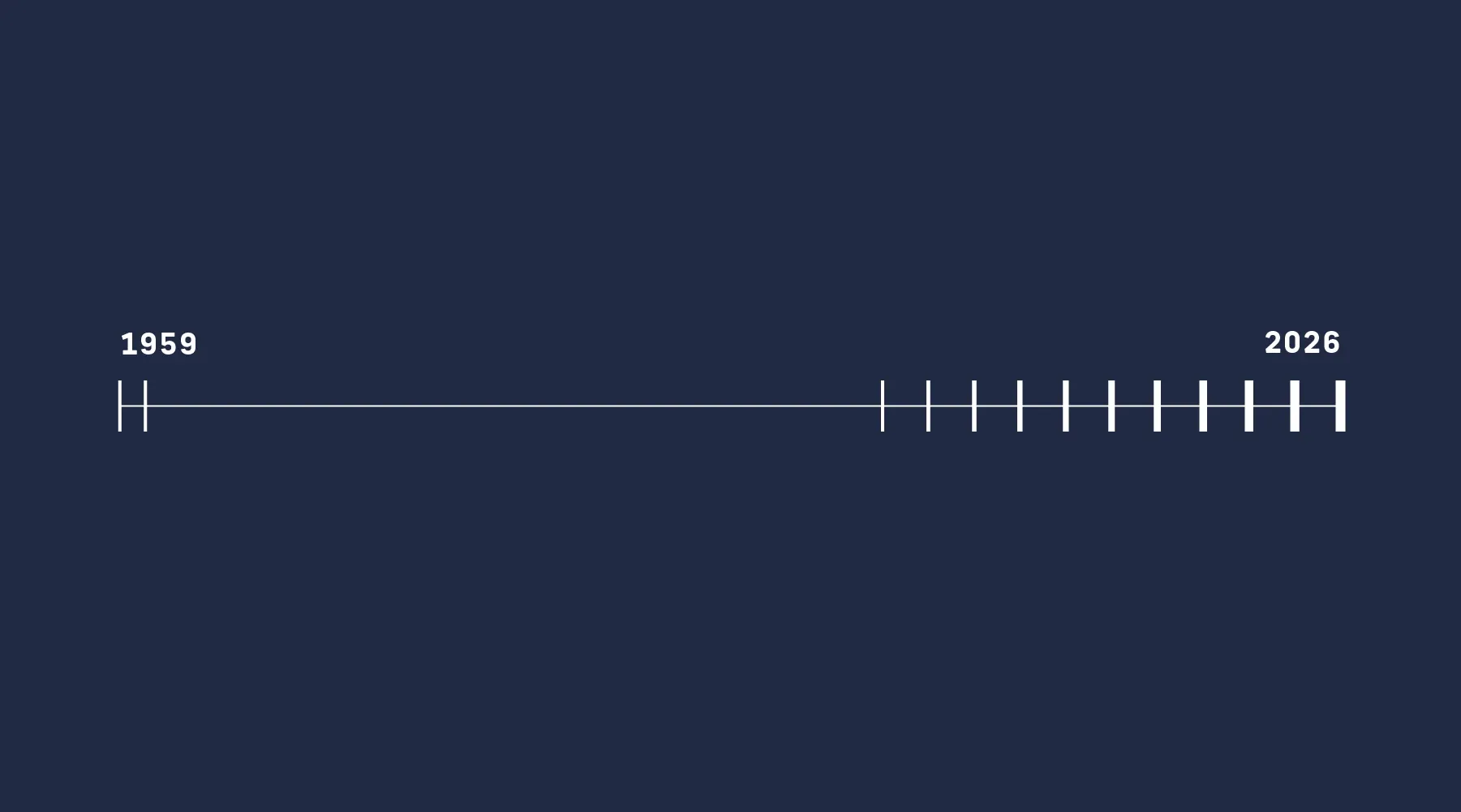
Bank Negara Malaysia had been established in 1959, and over the following decades the country built its own banking sector and grew local financial institutions. But for payments, Malaysia remained largely cash-based well into the 1990s. Paying a bill meant a counter visit. Buying goods meant cash or cheques. Nearly four decades would pass between independence and the first shared electronic payment infrastructure.
Sixty-three years after the federation was formed, every Malaysian makes an average of 538 digital payments per year. More than one per day. All of it running on infrastructure designed, built, and operated by Malaysians. This is the story of how that happened, and what happened to the companies built on top of it.
| Year | Milestone |
| 1959 | Bank Negara Malaysia established |
| 1963 | Malaysia formed |
| — 33 years — | |
| 1996 | MEPS: first interbank ATM network |
| 2000 | IBG: electronic account-to-account transfers |
| 2002 | Domestic PIN-based debit cards |
| 2004 | Chip card migration complete (first in the world) |
| 2004 | FPX goes live |
| 2011 | BNM Financial Sector Blueprint (target: 200 e-payments/capita by 2020) |
| 2015 | JomPAY launches |
| 2017 | MEPS + MyClear merge → PayNet |
| 2018 | DuitNow: instant transfers by phone number |
| 2025 | 538 e-payments per capita (target was 200) |
Building the foundation (1996 to 2004)
The first piece of shared infrastructure arrived in 1996. The Malaysian Electronic Payment System (MEPS) launched the country's first interbank ATM network, connecting banks that had previously run separate, incompatible systems. A Maybank cardholder could now withdraw cash at a Public Bank terminal. It was a foundational step: shared infrastructure between competing banks required coordination, trust, and a central mandate. It set the pattern for everything that followed.
Interbank GIRO (IBG) came in 2000, enabling electronic account-to-account transfers between banks without a branch counter visit. Domestic PIN-based debit cards arrived in 2002. The nationwide chip card rollout began in 2003.
Then 2004 brought two firsts in a single year.
FPX (Financial Process Exchange) went live, creating a system for real-time internet-based bank payments. For the first time, a customer could pay a merchant online by logging into their bank, authorizing the transfer, and receiving confirmation within seconds. No card number required. FPX connected directly to the customer's bank account, making it fast, low-cost, and accessible to anyone with online banking. It would become the backbone of online payments in Malaysia.
In the same year, Malaysia completed the migration of every ATM and debit card in the country from magnetic stripe to chip. Every card, every terminal, nationwide. That required replacing millions of cards and thousands of ATM terminals across the country, coordinating across every issuing bank simultaneously. A single bank moving alone would have gained nothing; the entire network had to switch together. Malaysia was the first country in the world to finish this migration. The United Kingdom completed its chip-and-PIN rollout in 2006. The United States did not begin its chip transition in earnest until 2015, more than a decade later.
The infrastructure matures (2011 to 2018)
In 2011, Bank Negara Malaysia published its Financial Sector Blueprint, a 10-year roadmap that identified electronic payments as one of nine strategic focus areas for the national financial system. The Blueprint set an ambitious target: 200 e-payments per capita by 2020.
JomPAY launched in 2015, giving Malaysians a single system to pay bills across participating banks and billers. Utilities, telecoms, government fees: one reference number, any bank.
Then on 1 August 2017, MEPS merged with MyClear, the country's electronic clearing house, to form Payments Network Malaysia (PayNet). The merger consolidated Malaysia's payment infrastructure under one entity, fully owned by Bank Negara Malaysia and the country's financial institutions. The payment system was no longer spread across multiple operators.
DuitNow followed in 2018: instant fund transfers by mobile number or IC number, across all participating banks and e-wallet providers. For the first time, a Malaysian could send money to anyone with a phone number, regardless of which bank either person used, and the transfer would arrive in seconds. The real-time payment network Malaysia had been building toward for two decades was live.
Where we are now
The numbers from 2025 tell the story of what Malaysia built.
The country recorded 18.4 billion electronic payment transactions, a 25% increase from 14.7 billion the year before. The average Malaysian made 538 digital payments, up from 432 in 2024. That is more than one digital payment per person per day.
DuitNow QR transactions alone hit 3 billion, doubling from 1.5 billion in 2024. Nearly 3 million merchant touchpoints now accept DuitNow QR across the country. Point-of-sale card transactions are projected to overtake ATM cash withdrawals for the first time, with POS accounting for 50.2% of total card transaction value.
The infrastructure is connecting internationally too. Cross-border QR transactions surged 179% year on year, with 29 live instant payment connections now active across ASEAN. Tourists from Thailand, Singapore, and Indonesia can pay Malaysian merchants by scanning the same DuitNow QR code with their own banking apps. In October 2025, BNM launched RENTAS+, making Malaysia's real-time gross settlement system the first in ASEAN to operate 24/7.
Looking ahead, BNM has mandated that all proprietary QR payment networks be phased out by June 2028, with all QR payments running on shared interoperable infrastructure. One QR code, accepted by every participating app.
BNM's Financial Sector Blueprint had targeted 200 e-payments per capita by 2020. The country passed that mark in 2021, reaching 222. By 2025, it had nearly tripled it.
| Year | Digital payments per person (MYR) |
| BNM 2020 target (set 2011) | 200 |
| 2021 (target first exceeded) | 222 |
| 2024 | 432 |
| 2025 | 538 |
The companies that grew on top
As the infrastructure matured, a wave of payment companies launched to connect merchants to these rails. They built the software layer: payment gateways, checkout pages, APIs, and merchant dashboards that let any business accept electronic payments.
iPay88, founded in 2000, was among the earliest Malaysian payment gateways, helping businesses accept online payments when e-commerce was still finding its footing in the country. MOLPay launched in 2005 and built a payment gateway presence across Southeast Asia. Billplz started processing payments in 2012. SenangPay entered the market in 2015 with a focus on small businesses and simplified onboarding. Curlec launched in 2018, starting with direct debit for recurring payments.
Then the acquisitions began.
In 2015, iPay88 was acquired by NTT DATA, a Japanese IT services company. It was renamed NTT DATA eCommerce Solutions in 2025.
In 2018, MOLPay was absorbed into Razer Inc, a Singapore-headquartered company, as Razer Merchant Services. It later rebranded to Fiuu, operating as a Razer subsidiary.
In February 2022, Curlec's majority stake was acquired by Razorpay, an Indian fintech company. It now operates as Razorpay Curlec.
Also in 2022, SenangPay was acquired by DOKU, an Indonesian payments company.
Most of the major Malaysian-founded payment gateways that grew on these rails were acquired by foreign companies between 2015 and 2022. Billplz remains Malaysian-founded and majority Malaysian-owned.
| Company | Founded | Acquired by |
| iPay88 | 2000 | NTT Data (Japan), 2015 |
| MOLPay | 2005 | Razer (Singapore), 2018. Now Fiuu. |
| Billplz | 2012 | — |
| SenangPay | 2015 | DOKU (Indonesia), 2022 |
| Curlec | 2018 | Razorpay (India), 2022 |
Built here
The payment system Malaysians use every day was designed, built, and operated by Malaysians. From the first shared ATM network in 1996 to a system processing 18.4 billion transactions a year, every layer was made here. MEPS. FPX. PayNet. DuitNow.
Selamat Hari Malaysia.