What actually makes up payment gateway costs in Malaysia

Oct 5, 2026
7 min
You get two quotes, pick the one with the lower percentage, and six months later you are paying more than you would have on the other. Nobody misled you. You compared one line item from a structure that has six or seven of them.
Payment gateway cost in Malaysia is a structure, not a number. This article carries no real figures, because a rate written today is wrong within a year. Current Billplz rates are at pricing. What follows is the model, which does not change, and a list of questions to ask any provider.
How payment gateway costs are charged per transaction
Almost every provider charges per transaction in one of two shapes, or both at once. A flat amount is the same regardless of sale value: predictable, and proportionally heavy on small baskets. A percentage scales with the value: gentle on small baskets, and it keeps growing on large ones. A hybrid is both.
Any flat amount and any percentage rate cross at a particular transaction value. Which is cheaper depends on which side of it you sit.
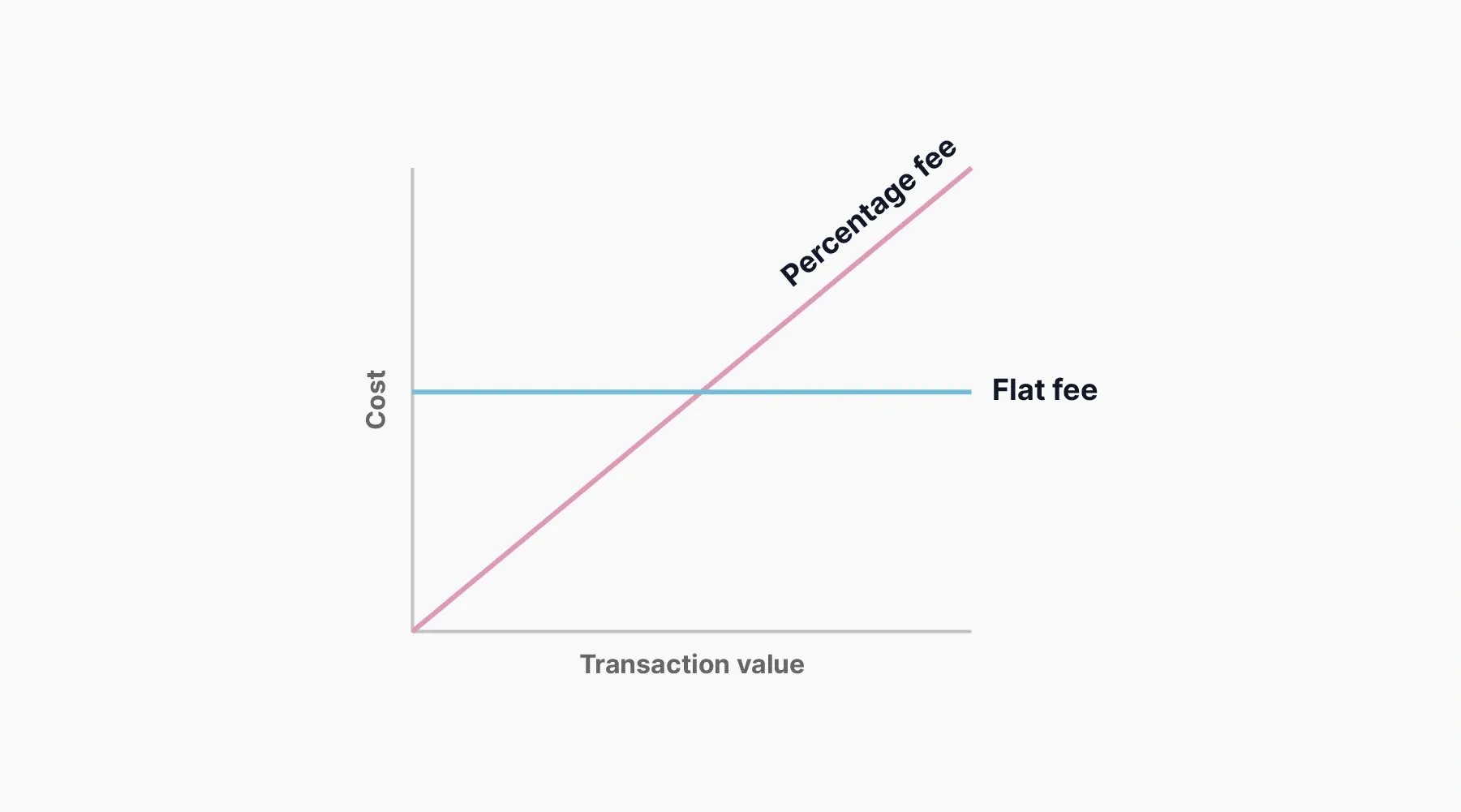
Work out your own average transaction value and find where the models cross for you. A business selling snacks and one selling furniture should reach different conclusions from the same pair of quotes.
The same logic applies to plans. A plan with a monthly or annual fee and a lower rate breaks even with a no-fee, higher-rate plan at a certain monthly volume. If your sales are seasonal, check your quiet months too.
What sits inside a merchant discount rate
On card payments, the headline rate is usually the merchant discount rate, or MDR. It is not one fee. It is a bundle of three things:
- Interchange, which goes to the bank that issued your customer's card
- A scheme fee, which goes to the card network
- The acquirer or gateway margin, which goes to your provider
Only the last one is negotiable with your provider. The other two are set elsewhere and passed through. This is why two providers can quote different MDRs while most of what you pay is identical underneath.
The interchange component is affected by the merchant category code assigned to your business, which classifies what you sell. Our guide to merchant category codes explains how they are assigned, and the merchant discount rate guide covers the full mechanics.
The costs that have nothing to do with volume
These are the ones that surprise people, because they arrive whether or not you sell anything.
Setup and onboarding fees
A one-off charge to open the account, sometimes waived. The question worth asking is what happens if verification fails partway through: is it refunded, or have you paid for an account you never got.
Monthly minimums
A floor. If your transaction charges for the month fall below it, you are billed up to it anyway. This catches seasonal businesses hardest: a merchant with one strong quarter and three quiet ones can pay minimums through the quiet months that erase the saving on a lower rate.
Annual or membership fees
Paid up front for a term. Ask whether it is pro-rated if you leave partway through, because often it is not.
The contract is a cost
This is the part nobody reads and the part that decides whether a cheaper rate is actually escapable.
- Minimum term and notice period. How long are you committed, and how much notice to leave.
- Repricing. Can the provider change your rates mid-term, and with how much notice.
- Exclusivity or volume commitments. A preferential rate often carries a condition.
- Termination terms. Is there a charge for leaving early.
- Funds in settlement at closure. What happens to money taken but not yet paid out, and how long until you see it.
A low rate inside a three-year contract with a repricing clause is not a low rate. It is an option the provider holds over you.
Settlement timing is a cash-flow cost
Settlement is usually expressed as T plus a number of business days: T is the transaction, and the number is how long until the money reaches your account.
It is set per payment method, not per provider, and weekends and public holidays extend it.
The cost never appears as a line item. A longer settlement window is working capital sitting still. If you are buying stock to fulfil orders you have already been paid for, that gap is a financing cost nobody invoices you for.
Some providers also charge a fee each time they pay out to your bank account. It is rarely part of the headline rate, so ask.
Billplz publishes payout timing per payment method on the pricing page.
What it costs when money goes back out
The least-published part of payment pricing, and therefore the part most worth asking about directly.
Refunds. Does the original transaction fee come back to you, or does the provider keep it? Is there a separate charge to process the refund? Providers answer differently and most do not publish it.
Chargebacks. A disputed payment usually carries a per-case fee. Ask whether you still pay it if you win, how long you have to respond, and what evidence is required. A short response window is itself a cost, because someone has to be watching.
Domestic and international cards are priced differently
If you sell outside Malaysia, cross-border card transactions carry a higher interchange component than domestic ones. That difference is structural, not a choice your provider made.
On top sit currency costs: whose exchange rate is used, what margin is applied, and whether dynamic currency conversion is offered at checkout, which changes who bears the conversion cost. All separate from MDR and worth asking about separately. For how card acceptance is set up, see how to accept credit card payments in Malaysia.
What you can negotiate and what you cannot
Not every line item is your provider's to change. Knowing which is which tells you where pushing back can work.
| Cost | Who receives it | Can you negotiate it with your provider? |
| Interchange (cards) | The bank that issued your customer's card | No, it is passed through |
| Scheme fee (cards) | The card network | No, it is passed through |
| Provider margin and per-transaction charges | Your provider | Sometimes, usually with volume |
| Setup, monthly and annual fees | Your provider | Sometimes |
| Payout fees | Your provider | Ask |
| Refund and chargeback fees | Your provider | Ask |
| Currency conversion margin | Whoever converts the currency | Ask, or choose who converts |
| Contract terms | Your provider | Worth trying, before you sign |
If a quote shows one blended rate, ask for it itemised, so you can see which part is the provider's.
Work out your effective rate
Every item above lands on the same bill. To compare providers fairly, work out your effective rate: everything you paid the provider in a month, divided by the value of the payments you took. Include transaction charges, fixed fees, payout fees, and refund and chargeback costs.
A low headline rate with several fixed charges can come out higher than a plain rate, and only this sum shows it. Comparing quotes rather than bills? Run your last few months of sales through each provider's published terms.
How to tell whether pricing is actually transparent
Every provider says its pricing is transparent, so the word alone tells you nothing. The test is whether every line item on your bill is published somewhere you can read before you sign.
A published standard passes that test, because its requirements are written down independently. Billplz, for example, is Pekeliling Perbendaharaan Malaysia PS 2.1 Compliant, a Malaysian government payment standard, and the security page describes what that covers: "We meet the Malaysian government's payment standards: real-time settlement, capped transaction costs, and transparent pricing." That is compliance with a standard, not a government endorsement of Billplz.
Where Billplz sits
Billplz publishes its terms on one page. Three plans, Basic, Standard and Enterprise, with rates and conditions for each at pricing. Payment methods are FPX, Wallet, Card and Instalments.
Honest about fit: Billplz handles online payments. To accept cards in person across a counter you need a terminal from a bank or terminal provider, a different product with a different cost structure. The framework above still applies, but the provider will not be a payment gateway.
Questions to ask any payment provider
Print this. Most of these can be answered with a yes, a no, or a number, which is the point: a provider who needs a paragraph is telling you something.
On the rate 1. Is the per-transaction charge a flat amount, a percentage, or both? 2. Does it differ by payment method, and what is it for each one I will use? 3. For card payments, is the quoted rate the full MDR or only your margin? 4. Are domestic and international cards priced differently, and by how much?
On fixed costs 5. Is there a setup or onboarding fee, and is it refundable if verification fails? 6. Is there a monthly minimum, and what happens in a month where I fall below it? 7. Is there an annual or membership fee, and is it pro-rated if I leave?
On the contract 8. What is the minimum term and the notice period? 9. Can you reprice mid-term, and with how much notice? 10. Is my rate conditional on exclusivity or a volume commitment? 11. Is there a charge for leaving early?
On money going back out 12. When I refund a customer, do I get the original transaction fee back? 13. What is the chargeback fee, and do I still pay it if I win the dispute?
On cash flow 14. What is the settlement timing for each payment method, in business days? 15. Is there a fee each time you pay out to my bank account? 16. If I close my account, what happens to funds still in settlement?
FAQs
What is MDR and how is it different from a payment gateway fee?
MDR, or merchant discount rate, is what you pay to accept a card payment. It bundles three parts: interchange to the bank that issued the card, a scheme fee to the card network, and your provider's margin. On card payments, your provider's fee is that margin, and it is the only part you can negotiate.
How much does a payment gateway cost in Malaysia?
There is no single figure. Your cost depends on the payment methods you accept, your average basket size, your volume and any fixed charges on your plan. A single quoted rate is one line item, not your total cost. Add everything up for a typical month to get your effective rate. Current Billplz rates are published at main.billplz.com/pricing.
Is a lower percentage rate always cheaper?
No. A percentage rate and a flat per-transaction amount cross over at a particular basket size. Below it the percentage is cheaper, and above it the flat amount is. Work out where the crossover sits for your own average transaction before comparing quotes.
Do I get the transaction fee back when I refund a customer?
It depends on the provider, and most do not publish it. Some return the original transaction fee, some keep it, and some charge a separate fee to process the refund. Ask before you sign.
The rate is not the cost
The cheapest rate and the total cost are not the same thing, and the gap between them is where most of the money goes. Find your crossover point, work out your effective rate, and read the termination clause. A provider who answers all sixteen questions above without hesitating is telling you something useful, whatever the numbers turn out to be.